

Why the Right Path Rarely Looks Like the Safe One | with Kelia Moniz

The Story
What happens when the path that feels right is the one nobody else would choose?
Kelia Moniz grew up in Kuliʻouʻou with four brothers, a 12-passenger van full of soft-top surfboards, and parents who turned Waikīkī Beach into both a classroom and a livelihood. Every morning at 6:30, the family loaded up: boards, pop-up tent, school supplies, food for the day. Their father, Tony Moniz, a former professional surfer, ran a grassroots surf school on the beach. Their mother set up a small table under the tent, and the kids did their schoolwork before they could touch the water.
“My mom was very serious. We were not allowed to leave the tent until we were done with school.”
It was unconventional and resourceful. And it planted something deep: discipline and passion are not opposites. They’re partners.
As Kelia got older, surfing became more than family tradition. She remembers the day a bus of Roxy-sponsored girls pulled up to Waikīkī. They were vibrant, confident, surrounded by photographers. Something shifted inside her. She grabbed her board and paddled right into their lineup. She was 13 when she set her sights on becoming a Roxy girl. She printed a resume, gathered her best photos, and begged her dad to send it.
He refused. Not out of cruelty. Out of wisdom.
“Let your surfing do the talking, babe.”
When Roxy eventually came to her, the sponsorship felt earned. That lesson stayed.
Then came the crossroads. At 16, after winning a national shortboard title, Kelia felt something unexpected: not excitement, but exhaustion. The QS tour path, with its relentless grind and year-round competition, didn’t match what she felt inside. Longboarding did. But longboarding had no real tour, almost no money, and no proven career path.
“I basically told my dad, I don’t want to shortboard anymore. I’m going to longboard.”
His response: “All right. Whatever you want to do next, you’re going to have to work really hard to find a lane.”

So she found one. She won two world longboard titles. She built a career blending surfing, lifestyle, and storytelling into something that didn’t exist before she created it. For 17 years, Roxy backed her.
Then a private equity acquisition gutted 70% of the brand’s marketing budget. Kelia was offered a 90% pay cut to stay. She walked away.
“I just knew in my heart that I couldn’t do it. I couldn’t set a bar for the next generation.”
Today, Kelia is building on her own terms. She and her husband opened Honolulu Pawn Shop, a retail concept at The Surfjack Hotel in Waikīkī that brings together fashion, art, and community experiences. It’s a physical expression of the creative, independent vision she’d been carrying since childhood.
“I have no idea what’s ahead. And I’m really excited for that.”
The girl who followed a van full of Roxy girls into the lineup chose, in the end, to build her own lane entirely.
And the pattern that shaped every one of those decisions, choosing what feels true over what looks safe, is the foundation of the deeper insight.
The insight
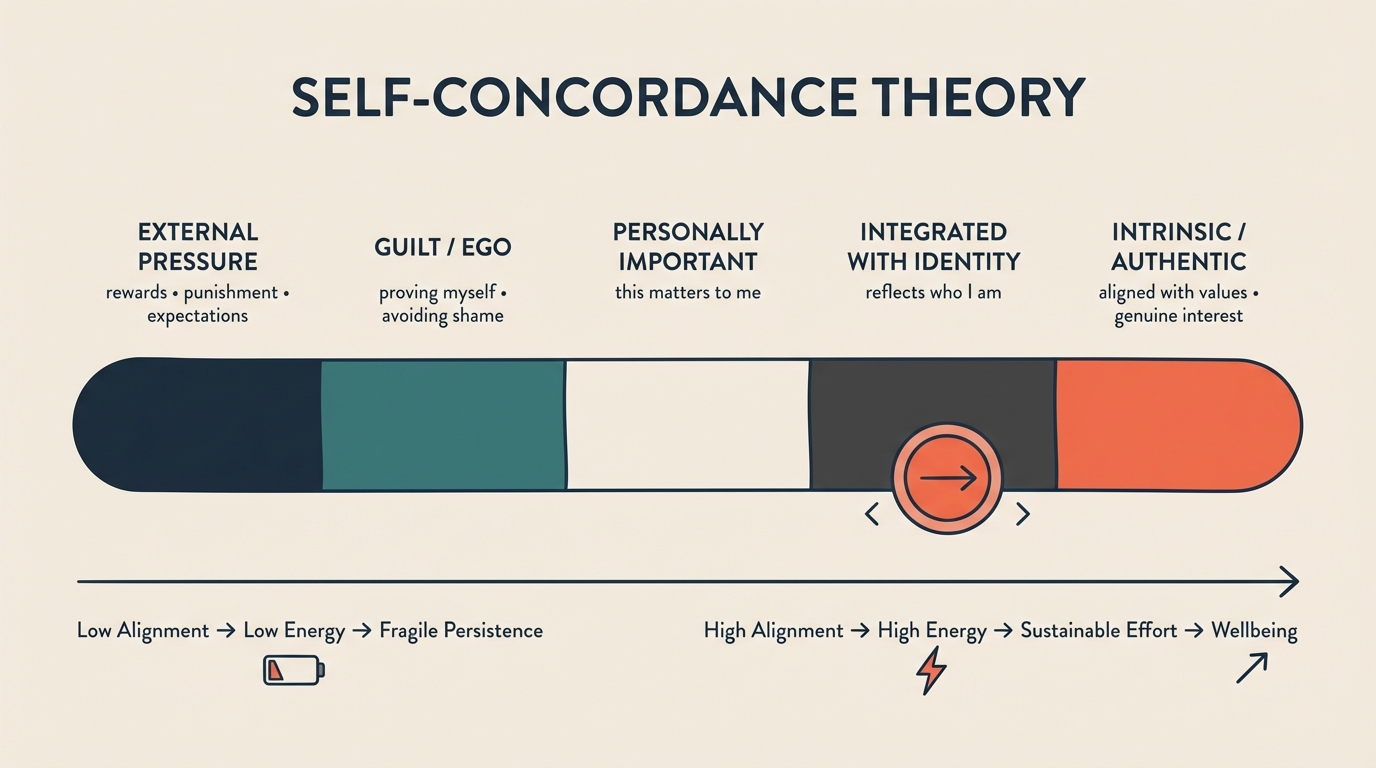
Psychologists Kennon Sheldon and Andrew Elliot developed what they call Self-Concordance Theory to explain a pattern that shapes how people pursue goals and whether those goals actually lead to fulfillment.
The idea is simple. Not all goals are created equal. Some come from external pressure: expectations, money, status, or the fear of disappointing others. Researchers call these controlled motivations. Other goals come from within, from genuine interest, personal values, or a deep sense that something is right for you. These are autonomous motivations.
Sheldon’s research found that people who pursue self-concordant goals, goals aligned with who they truly are, show greater persistence, more sustained effort, and significantly higher well-being over time. Even when the path is harder. Even when the external rewards are smaller. The alignment itself becomes the engine.
When what you chase matches who you are, the work doesn’t drain you. It fuels you.
Kelia’s career followed this arc precisely. At 16, the controlled path was clear: stay on shortboard, grind the QS tour, chase rankings and prize money. The autonomous path had no roadmap. She chose alignment. Years later, when Roxy offered her a fraction of her value, the controlled motivation would have been to stay. It was comfortable. It was 17 years of identity. But her values, and her sense of what she owed herself and the next generation, pointed toward the door.
She chose alignment again. And then built Honolulu Pawn Shop, a venture born entirely from her own vision, not someone else’s brand.
Sheldon’s research reminds us that the goals that sustain us are not always the ones that look safest or most logical from the outside.
They are the ones that feel true from the inside.
the application
We all know the pull of the safe path.
It shows up as the job that pays well but doesn’t excite you. The major that looks impressive on paper but leaves you flat. The relationship, role, or routine that everyone else approves of but quietly pulls you away from who you’re becoming.
The safe path is easy to justify. It has structure. It has validation. And most of the time, no one will question you for staying on it.
But self-concordance research tells us something uncomfortable: the goals we pursue to meet other people’s expectations tend to burn us out, even when we succeed. And the goals that come from genuine alignment tend to sustain us, even when the road is harder.
Kelia didn’t have a guaranteed outcome when she chose longboarding over shortboarding. She didn’t have a business plan when she walked away from Roxy. What she had was clarity about what felt right, and the willingness to work harder because of it, not in spite of it.
That’s the difference. Alignment doesn’t remove difficulty. It gives difficulty a reason.
You don’t need a perfect plan to move.
You don’t need everyone to understand your choice.
You don’t need the outcome guaranteed before you begin.
You just need to trust that the path pulling you forward is yours.
What We Can Steal
Follow alignment, not applause.
The goals that sustain you long-term are the ones that match your values, not the ones that impress the room.Let your work speak first.
Credibility built through action lasts longer than any shortcut. Earn it, and it becomes part of who you are.Know the difference between a clear path and the right one.
Just because a direction is well-lit doesn’t mean it leads where you need to go. Sometimes the path with no map is the one that fits.Walk away when staying costs you your standards.
Accepting less than your value doesn’t just affect you. It sets a ceiling for everyone who comes after.
Mahalo for reading this week’s Mana‘o Bomb.
Next week, we’ll drop another idea from Hawai‘i. A story that sparks growth, resilience, and purpose.
Keep rising. Keep learning.