

When Being Humble Sometimes Works Against You | with Sheldon Simeon
The Story
What if the thing standing between you and your next level isn’t a lack of talent, but the moment you’re too afraid to step into?
Before the James Beard nominations, before the cameras, before the fire extinguisher that almost ended it all, there was a kid from Hilo who believed superstars came from somewhere else.
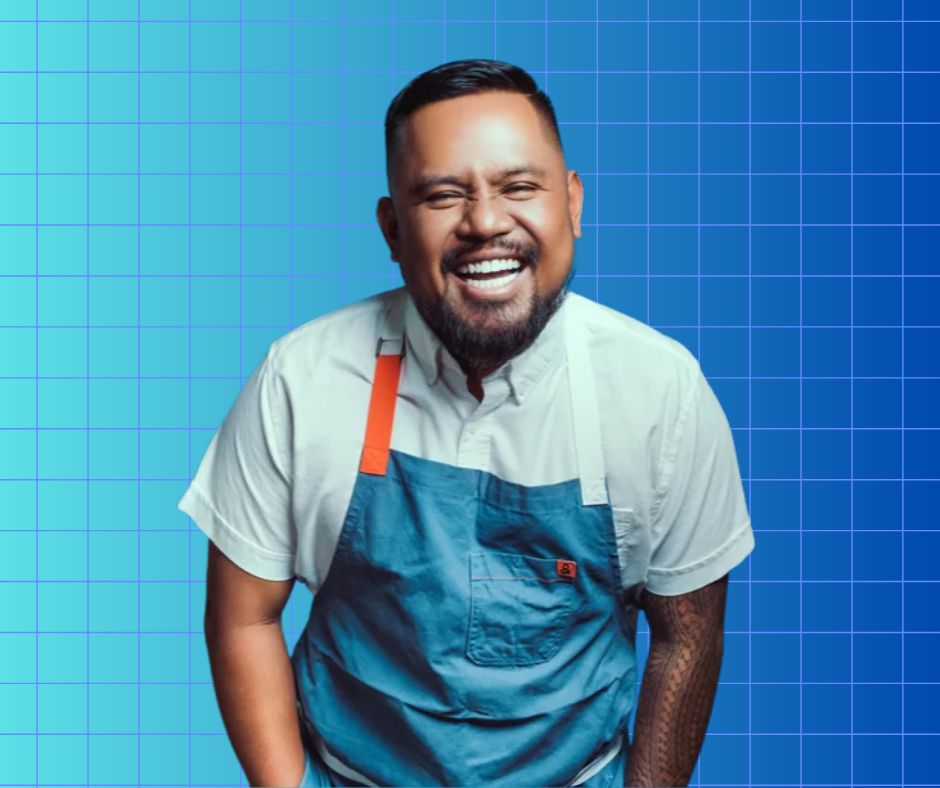
Sheldon Simeon grew up on the Big Island, a proud Hilo High Viking, Class of 2000. His family was everything. Tight-knit, local, rooted. The kind of household where you learn early to be humble, soft-spoken, and to never draw attention to yourself. Food was always at the center. Not as ambition, but as love. As gathering. As home.
After graduating, Sheldon left Hawaiʻi for an internship at Walt Disney World in Florida. For a local kid raised on family above all else, it felt enormous.
“Local style is like family is everything,” he says. “So to be going away for a minute, that was a huge decision.”
The mainland opened his eyes, and eventually brought him a wife, Janice, a local girl he met all the way in Florida. Together, they returned to the islands.
What followed was years of grinding. Prep cook and dishwasher at Aloha Mix Plate on Maui. He didn’t leapfrog. He scrubbed, chopped, and earned every rung. Line cook. Sous chef. Chef. When the opportunity came to be the opening chef at Star Noodle, he poured everything into it.
“I wasn’t the most talented guy. I knew that,” he says. “But I knew my hard work and ethic was going to get me through.”
Star Noodle took off. Awards followed. Local publications, Food & Wine, James Beard recognition. Sheldon was building something real. And then the phone rang.
He was in the dish pit. The dishwasher had called in sick, so Sheldon, the chef, was elbow-deep in grease, scrubbing plates while managing orders. A hostess came up: someone’s on the line for you. “Can you see there’s all these dishes piled up?” he told her. “Can you just take a message?”
It was a casting call for Top Chef, the popular reality TV show on Bravo.
“I was like, here I am. Just covered in slop and just trying to get these dishes done. That’s for superstars, that’s for the superstar chefs. I’m just a guy that’s washing dishes right now.”
He went through the interviews, the videos, the recipe submissions. And the whole time, a voice in the back of his head kept whispering: “Is this real? This doesn’t happen to local kids.”
But it wasn’t the audition process that nearly stopped him. It was the weight of what it meant. Once word got out, everyone around him loaded expectations onto his shoulders. You’re going to crush it for Hawaiʻi. You’re going to put us on the map.
“That was a huge burden, man. It was just waiting on my shoulders of can you do this? That’s a lot to uphold, man. The pride of our islands is huge. And it was a moment that crossed my mind that, no, that’s too much to overcome.”
He almost didn’t go.
But he went. He packed his knives, “sharper than anybody else on the cast,” and flew to Seattle. While other contestants introduced themselves as chefs with six restaurants and Michelin stars, Sheldon stood there thinking one thing: “Am I good enough?”
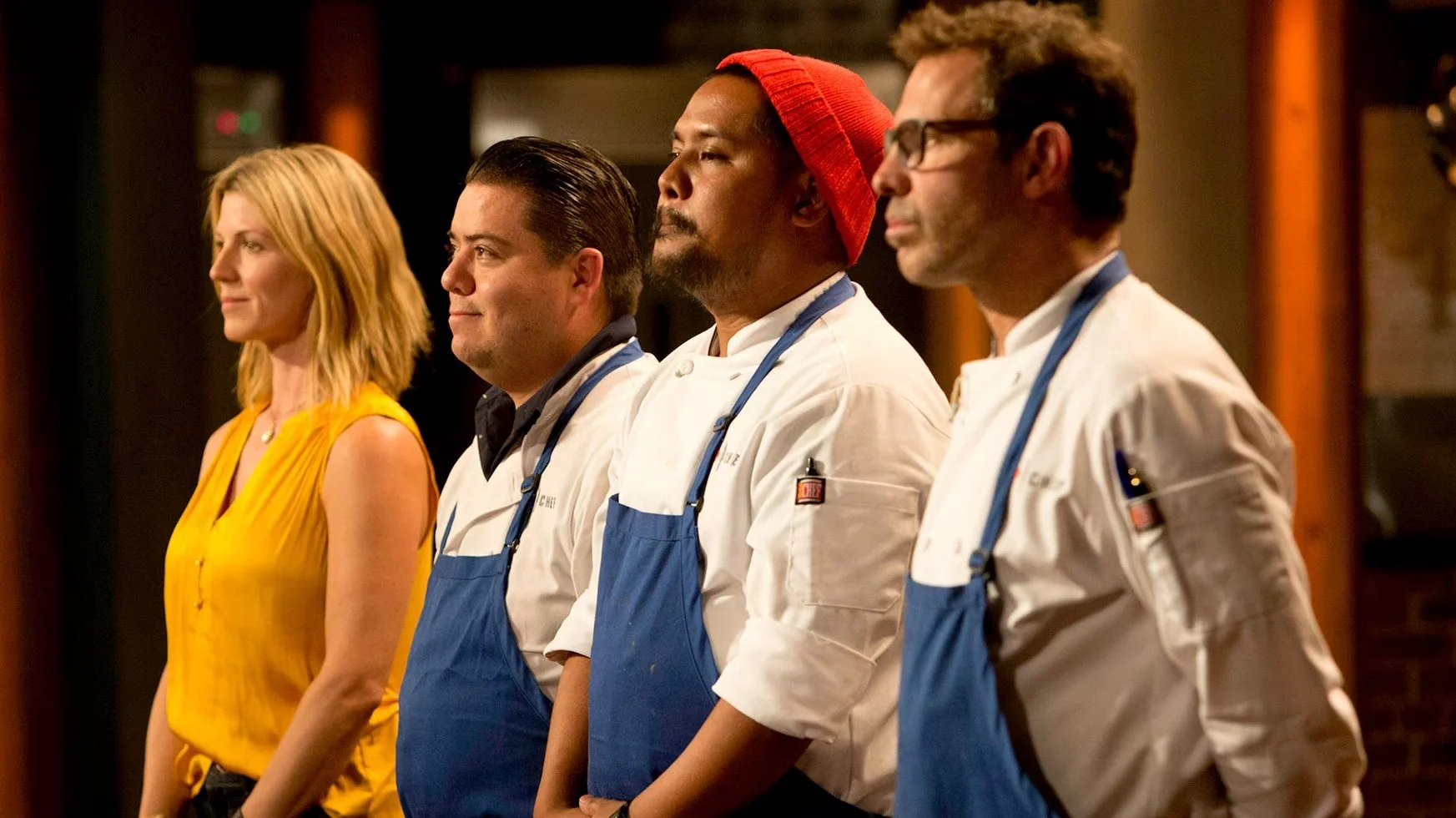
He won his first challenge. Cooked from the heart, made it to the finale, and finished as runner-up and fan favorite. But the finale taught him one more lesson: he’d tried to change his style to impress the judges, and it backfired. “I was being someone that I wasn’t. I was being fake and you can’t fake the funk, man.”
After Top Chef, he turned down offers to open restaurants in California and New York. He came home. And then he did the thing he’d always dreamed about: he bought an old okazuya in Kahului called Coco Ichibanya and turned it into his own place. Tin Roof.
He gutted the 25-year-old space himself. Ripped out drywall by day, cooked at another restaurant by night. Watched his savings, his 401k, every penny drain out of his accounts. On opening day, the last thing he needed was a fire extinguisher. No extinguisher, no opening. He bought one. It left him with two dollars to his name.
Today, Sheldon Simeon is a James Beard-nominated chef, the owner of Tin Roof and Tiffany’s Maui, and one of Hawaiʻi’s most celebrated culinary voices.
But when you ask him what made the difference, he doesn’t talk about recipes or technique. He talks about the moments he didn’t want to step forward, and stepped forward anyway.
“Growing up in Hawaii, you’re taught to be humble, to be soft spoken, and to be always in the background of things,” he says. “And sometimes that works against us because it works in self-doubt.”
Every breakthrough in his life came not from the cooking. He loved that part. It came from the moments he had to override something deeper: the fear of being seen, the weight of representation, the terror of going all in with two dollars left. The growth lived in the resistance.
The insight
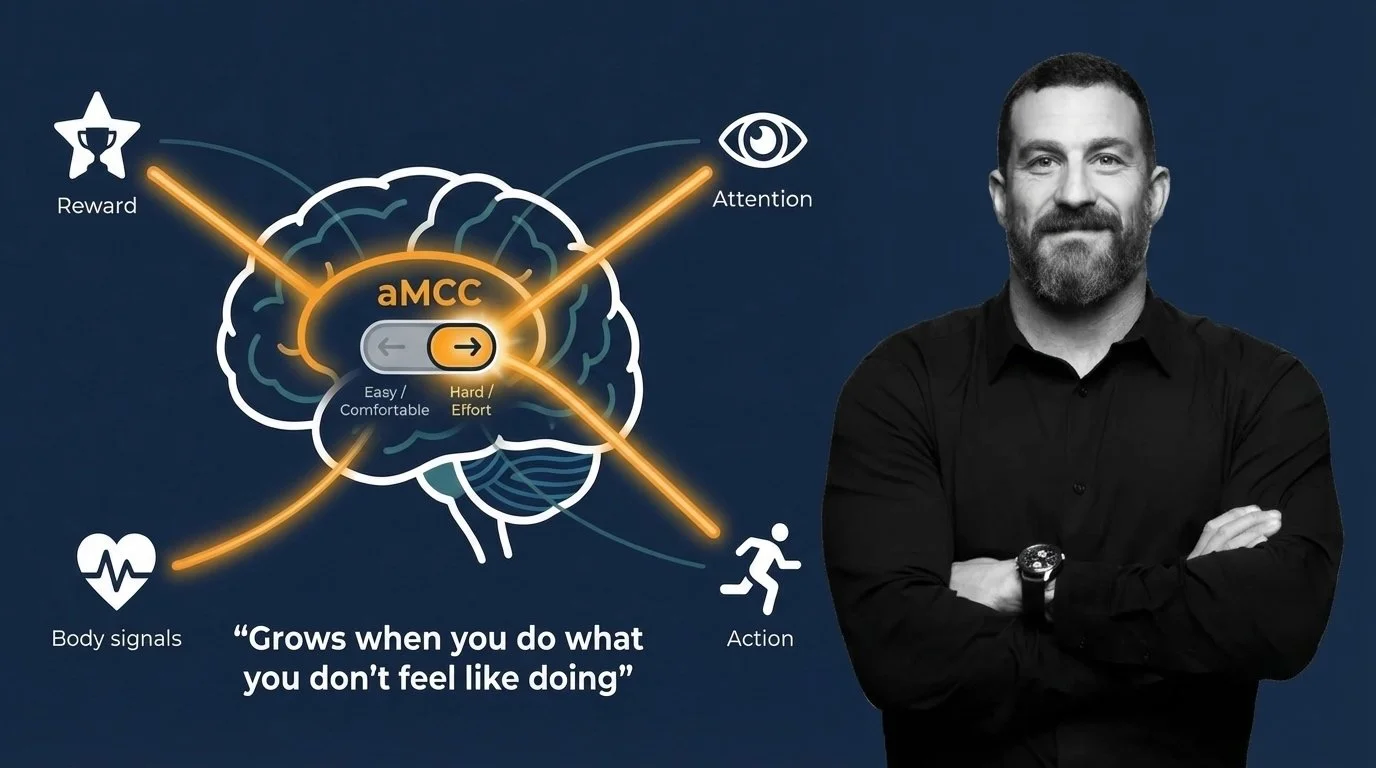
There’s a structure deep in the brain called the anterior mid-cingulate cortex, or aMCC. Researchers at Harvard and Massachusetts General Hospital have been studying it for years. What they’ve found challenges almost everything we think we know about willpower.
The aMCC isn’t a single-purpose willpower center. It’s one of the most densely connected hubs in the entire brain, sitting at the intersection of networks that handle attention, reward, motor planning, and your brain’s internal sense of what’s happening in your body. Think of it less like a muscle and more like a switchboard operator that asks one question:
Is this effort worth the energy cost, given what I might gain?
Here’s where it gets interesting. Neuroscientist Andrew Huberman, in a podcast with former Navy SEAL and ultrarunner, David Goggins, describes what makes the aMCC grow.
It’s larger in athletes.
It’s larger in people who diet.
It maintains its size in people who live exceptionally long lives.
Huberman calls it, potentially, “the seat of the will to live.”
But the critical finding, the one that separates this from every other “grind harder” message, is this: the aMCC doesn’t grow from doing hard things. It grows specifically from doing things you don’t want to do.
If you love cold plunges, cold plunges don’t count. If you love running, running doesn’t count. The psychological resistance is the active ingredient, not the difficulty.
Look at Sheldon’s story through this lens. Cooking was never the resistance. He loved every minute in the kitchen. What he didn’t want to do was be seen. He didn’t want to carry the pride of Hawaiʻi on his shoulders. He didn’t want to introduce himself next to Michelin-starred chefs and wonder if he belonged. He didn’t want to drain his 401k to the last dollar on a 25-year-old restaurant.
Every single breakthrough in his life came at the exact point where his instinct said stop, and he kept going.
That pattern isn’t coincidence. It’s neuroscience.
Every time you override the voice that says “this is too much,” you’re not just surviving the moment. You’re physically building the part of your brain that makes the next moment possible.
the application
There’s a Hawaiian value (most certainly influenced by Japanese culture) that most of us grew up with that doesn’t always get talked about in this way: the tension between humility and hiding.
We were raised to be humble. Don’t make a scene.
“No make A”.
To let your work speak for you. And that’s beautiful. It’s one of the things that makes our communities what they are.
But somewhere along the way, for a lot of us, humility became a hiding place. We called it being respectful when really we were being afraid. We called it staying humble when we were actually staying small.
Think about the thing in your own life that you’ve been putting off. Not the thing that’s hard. You already do hard things. The thing you don’t want to do. The difficult conversation. The application you keep almost submitting. The phone call that makes your stomach turn. The room you don’t feel qualified to walk into.
That resistance you feel isn’t weakness. According to the research, it’s the exact signal that growth is available to you right now, in this moment.
We spend so much energy looking for the thing we love, the path that feels right, the career that sparks joy. And those things matter. But the aMCC research suggests that the deepest kind of growth, the kind that literally reshapes your brain, lives in the opposite direction.
It lives in the thing you’d rather not do.
Not forever. Not as punishment. But as practice. One override at a time.
What We Can Steal
Separate difficulty from resistance.
Hard work you enjoy builds skill. Work you resist builds willpower. The growth isn’t hiding in what comes naturally. It’s hiding in what you keep avoiding.Let humility be a foundation, not a ceiling.
Being soft-spoken and grounded is a strength. But when it becomes a reason to never speak up, it stops serving you. There’s a difference between being humble and being invisible.Willpower is a muscle.
Just like your body, you only get stronger through resistance training. The aMCC is your willpower muscle. It grows bigger only by constantly tackling the things you don’t want to do.Taste everything.
Not just in food, but in opportunity. The more you practice overriding resistance, the more capacity you build for the next moment that asks something of you.
Mahalo for reading this week’s Mana‘o Bomb.
Next week, we’ll drop another idea from Hawai‘i. A story that sparks growth, resilience, and purpose.
Keep rising. Keep learning.