

How to Rewrite the Story You Tell Yourself | with JT Ojerio
The Story
What happens when the person you’ve spent your whole life becoming is no longer the person you can be?
JT Ojerio grew up between two worlds: Pearl City sidewalks on one side, the red dirt of Waiʻanae Valley on the other, where her dad’s family lived. While her cousins chased chickens and wrestled in the yard, JT was right there with them, rough and tumble from the start.
“I was just like a straight up sports fanatic,” she says. “Nothing artsy.”
At Punahou, she found wrestling in sixth grade, and something clicked. The mat became her place, part competition, part therapy. By high school, she wasn’t satisfied watching from the sidelines. She walked onto the intermediate football team as a defensive lineman. Not a kicker. A defensive end, hitting and getting hit, figuring out where to stuff her hair inside the helmet.
Some boys hit her harder when they realized she was a girl. Some wouldn’t hit her at all. She went 100% either way.
But it was the wrestling mat that taught her the lesson she carried into everything that followed. Nine minutes. That’s all you get.
“If you don’t show up in those nine minutes, I’ve learned that you really should do your best at everything you do, because if you don’t, that’s when the regret starts to kick in.”
After Punahou, JT chased the thing she was built for. She earned her degree in exercise science at Northern Colorado, then a master’s in exercise physiology at the University of Illinois, Chicago. She became a personal trainer who specialized in working with people others might overlook. Quadriplegic patients, stroke survivors, amputees. She loved the work.
For over a decade, JT’s story made perfect sense: she was a physical person who helped other physical people perform.
Then the story stopped working.
It started with the hip surgery in 2016. Then strange symptoms she couldn’t explain. Her hair stopped growing. Her bones started breaking easily. Migraines, depression, a grip so weak she was afraid to hand a client a kettlebell. She moved home to Hawaiʻi in 2019, and the word she uses is the one that cuts deepest: failure.
Ten years of building a career in sports performance, and her own body wouldn’t cooperate.
“It was kind of like an identity crisis because my body stopped working, and I built my entire pathway on being able to perform and help other people perform.”
During that in-between time, with training sessions growing shorter and the diagnosis still unclear, JT started sketching. Just doodling on her iPad on the couch with her dog, trying to take her mind off the pain.
She didn’t think of it as a new direction. She didn’t think of it as anything.
Then one morning on Lanaʻi, where she’d taken a job at a wellness retreat, she brought a stack of prints into the break room. A coworker had seen her drawings and told her to sell them at the local art center. The women in the office stopped her before she could leave. They wanted to buy everything.
“I don’t know who was more surprised that I could draw, if it was my friends or myself.”
When the pandemic hit and JT lost her job, she opened a Shopify store for her art: Aloha de Mele, named after her beloved dog.
The store took off.
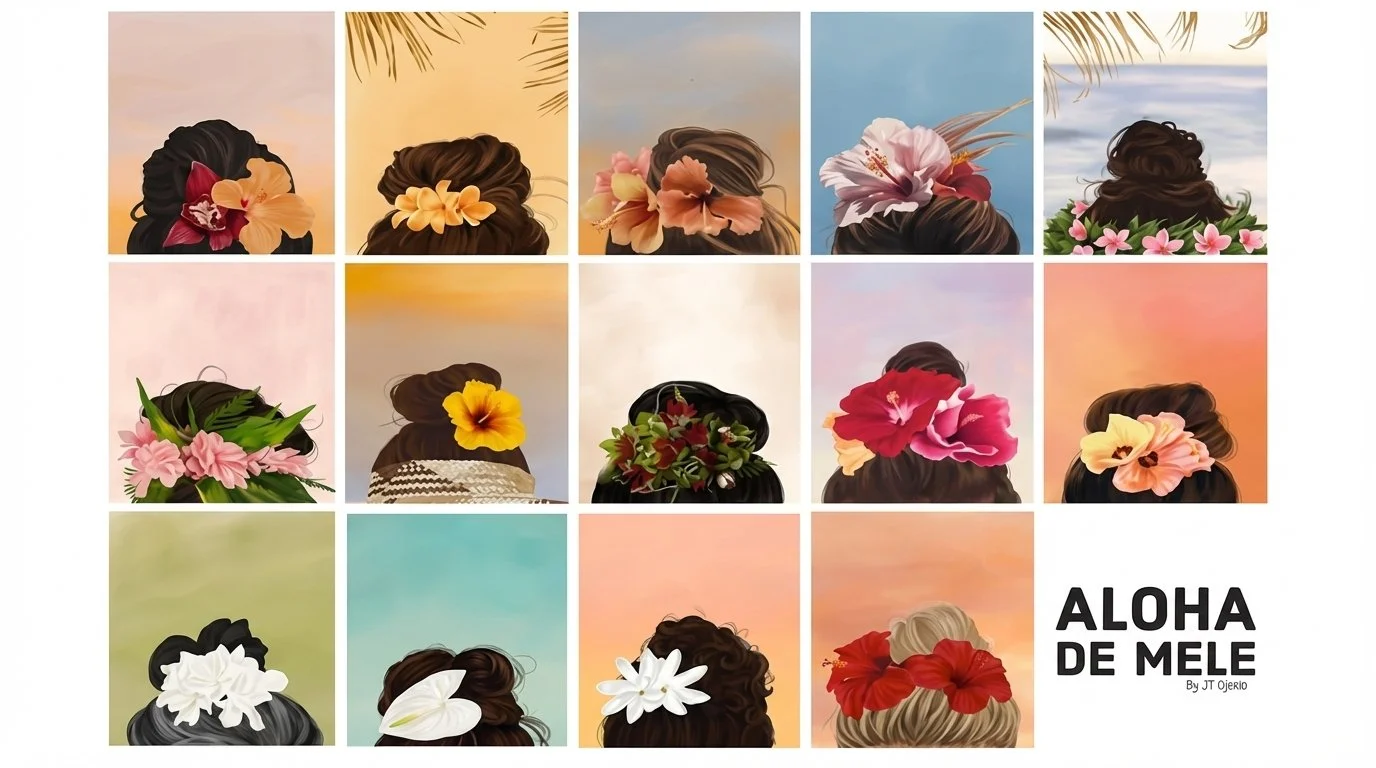
Then came McKenna Maduli’s show. Then Mana Up, cohort six. Then the moment that changed everything—she found Studio Hale, her fine art print shop, hired her first employees, and started doing what she’d always dreamed of at the largest scale.
Painting murals, building a creative space where other Hawaiʻi artists could print their work without being judged or priced out, and running a business born entirely from a chapter she never planned to write.
It took JT almost a full year to stop writing “personal trainer” on her tax return and write “artist” instead.
The old story didn’t disappear. It just turned out to be the first draft of a much bigger one.
The insight
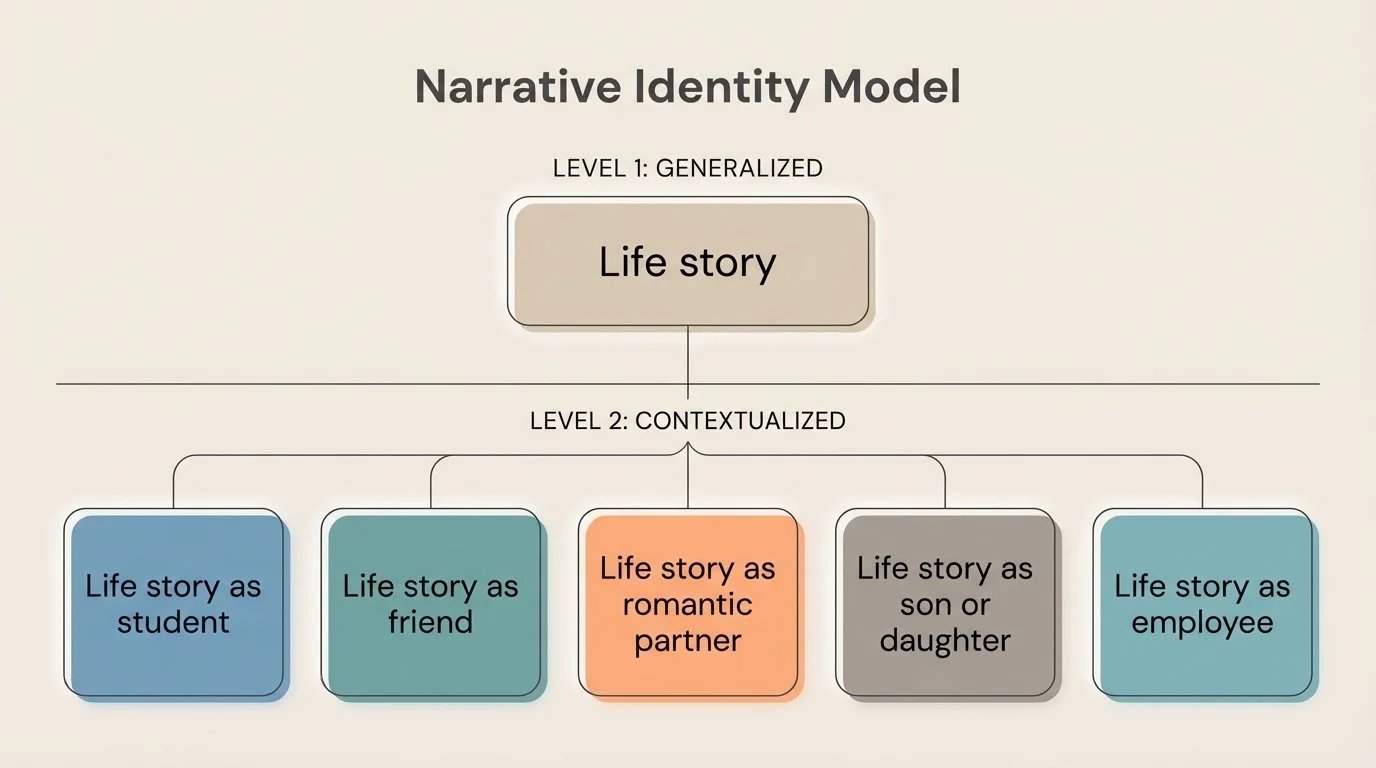
Psychologist and author Dan McAdams has spent decades studying a question most of us never think to ask: how do people make sense of their own lives?
His answer is a concept called Narrative Identity.
The idea is that each of us carries an internalized story about who we are. Not just a résumé or a list of facts, but a living, evolving narrative that connects our past, present, and future into something that feels coherent. We are, in a very real sense, the stories we tell ourselves about ourselves.
This story gives us direction. It tells us what to pursue, what to value, what feels like “us.”
But it also creates a trap.
When circumstances force the plot to change, we often cling to the old draft. We mistake the story for the person.
McAdams found that the people who navigate major life disruptions most successfully share a common skill…
They can reauthor their narrative.
They don’t deny what happened. They don’t pretend the difficult chapters weren’t painful. But they find a way to weave those chapters into a new story that still feels true.
He calls this a redemptive narrative.
The hard thing that happened doesn’t get erased. It gets reinterpreted as a turning point.
Look at JT’s journey through this lens and the pattern becomes clear. For over a decade, her narrative identity was built on performance.
Athlete. Trainer. The person who shows you what your body can do.
When her body failed, it wasn’t just a health crisis. It was a story crisis. The character she’d written for herself no longer fit the plot she was living.
The sketching on the couch, the year of not knowing what came next, the reluctance to call herself an artist even after her Shopify store exploded….that was the space between drafts.
The old story had ended, and the new one hadn’t been written yet.
The tax return was the turning point. When JT finally wrote “artist” instead of “personal trainer,” she wasn’t just updating a form. She was choosing a new narrative.
And in doing so, she discovered something McAdams’ research confirms again and again…
The new story doesn’t erase the old one. It builds on it.
JT’s competitive fire, her discipline from the mat, her understanding of the human body. All of it lives inside her art and her business. The chapters changed, but the author stayed the same.
We are not defined by the story we started with. We are defined by our willingness to write the next chapter.
the application
The koa tree only grows in Hawaiʻi. It’s one of the most beautiful, most valued trees on the islands. But here’s what most people don’t know about how it begins.
A koa seed has an incredibly hard outer shell. It can sit in the soil for years, perfectly dormant, waiting. It doesn’t germinate on its own.
It needs disruption. Fire. Scarring. Something has to crack the shell open before the seed inside can finally grow.
Most of us are carrying koa seeds we don’t know about.
We build a story about who we are. We commit to it. We let it guide us for years, sometimes decades. And when that story breaks, when the career ends or the body fails or the world shifts under our feet, we think something has gone wrong. We think we’ve lost the plot.
But sometimes the breaking is the point.
Sometimes the thing that cracks us open is the only thing that could have let the next version of us take root.
We all have chapters we didn’t plan to write. Skills we haven’t discovered yet because the conditions weren’t right. A version of ourselves waiting in the soil for the shell to crack.
The question isn’t whether disruption will come (It will).
The question is whether we’ll let it open us up, or whether we’ll spend our energy trying to glue the old shell back together.
JT didn’t choose for her body to fail. She didn’t choose the pandemic. But she chose to pick up the iPad and start creating. She chose to bring the prints into the break room. She chose to write “artist” on the tax return.
She chose to let the seed grow.
What We Can Steal
Let the old story end.
Clinging to a narrative that no longer fits doesn’t make you loyal to yourself. It keeps you stuck. The sooner you release a chapter that’s over, the sooner the next one can begin.Give yourself permission to be a beginner again.
You don’t need to feel ready before you start something new. Start before the confidence arrives. The doing is what creates the feeling, not the other way around.You can be good at more than one thing.
Your education, your training, your experience — none of it defines the boundary of what you’re allowed to become. The next thing you’re great at might be something you haven’t tried yet.Write the next chapter before you feel ready.
Don’t wait for the new story to feel comfortable before you commit to it. Clarity doesn’t come before action. It comes from it.
Mahalo for reading this week’s Mana‘o Bomb.
Next week, we’ll drop another idea from Hawai‘i. A story that sparks growth, resilience, and purpose.
Keep rising. Keep learning.