

Part 2 of 5: The Origin of RiseHI

Mom dropping me off to college in 1997
The Story
What happens when you meet someone who isn’t afraid of the thing that terrifies you?
Before the Broncos. Before the book. Before he stood next to me at my wedding, Nate Jackson was just a guy I didn’t want on my team.
To understand why, you have to go back to the plane ride out. When I was 18, I left Hawaiʻi for college still carrying that quiet programming from home. I didn’t know I was carrying it. I just made decisions that felt natural. Every one of them pointed toward comfort.
I had picked Menlo College for two reasons, both of them about staying close to what I knew. One, I still wanted to play football. I wasn’t a Division I scholarship kid, so it had to be a school where I could walk on. Two, I wanted to be around other kids from home. Menlo is a tiny Division III school in Atherton, California, right in the heart of Silicon Valley. It had about forty or fifty students from Hawaiʻi. That was the real reason.
For my first two years I barely left the bubble. We hung out in each other’s dorm rooms with ukuleles, playing local music. Care packages arrived from home with mochi crunch and li hing mui gummies. We spoke our own language. I wasn’t homesick for a single day. It felt like home, which was the point. Which was also the problem.
Junior year, Nate Jackson transferred in.
Same position as me. Same 6’4”, 200-pound frame. A white kid from San Jose. Brash, loud, a little cocky. He was competing for my spot. I did not go out of my way to make him feel welcome.
What I didn’t account for was what football does to two competitors on the same team. Midway through the season we found ourselves in a game we had no business winning, down late with time running out. Nate and I both made plays in the comeback. We won. When you fight through something like that with someone, the line between rivalry and friendship gets blurry in a hurry. After that game, we started hanging out.
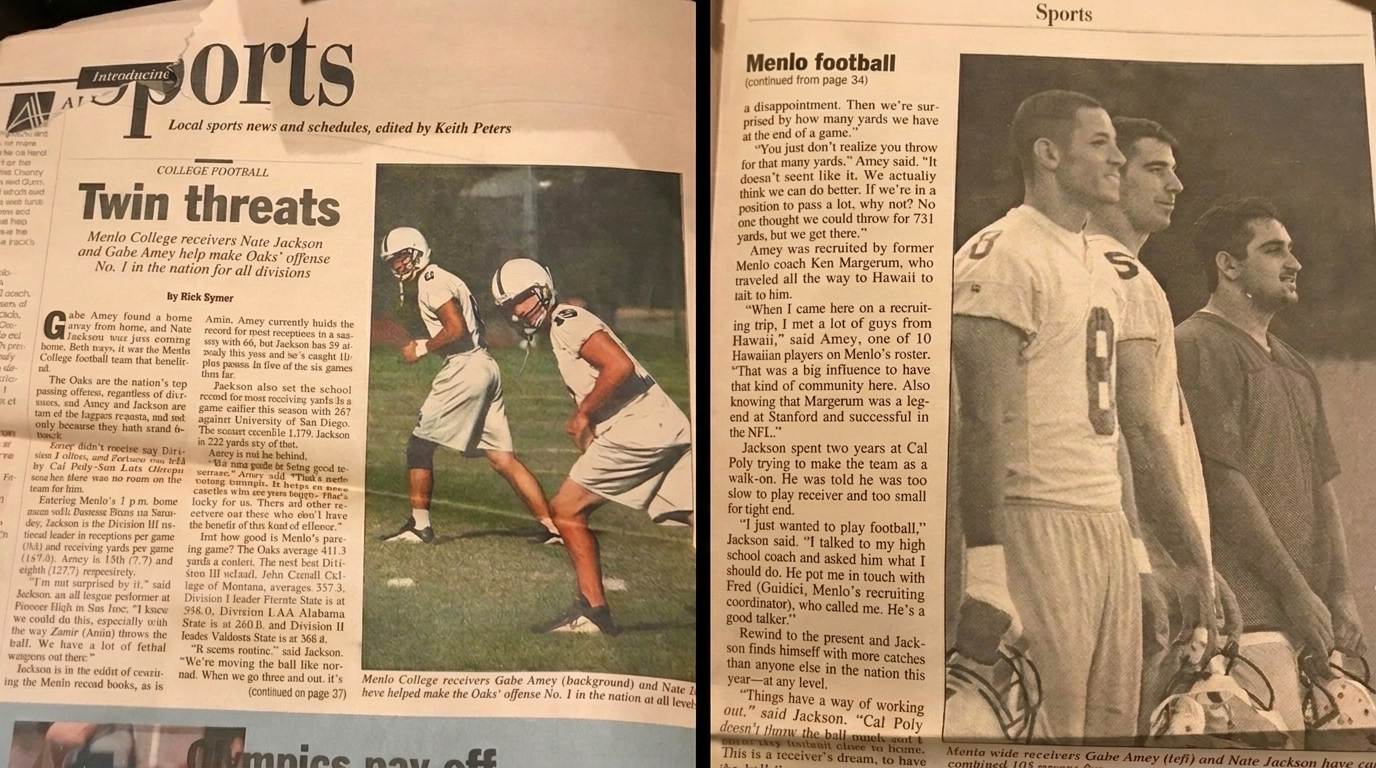
Nate’s story wasn’t what I expected. He’d started his college career at Cal Poly, trying out for their football team. The coaches cut him. They told him he was too slow to play wide receiver and too small to play tight end. He was crushed. He transferred to Menlo to keep playing.
That detail mattered more than I realized at the time. The guy who was competing for my job had been told, not long before, that he wasn’t good enough for football at all. He had been rejected. And here he was, on my field, clearly determined not to let that be the end of the story.
Nate wasn’t only a football player. He was also a musician, part of a rap duo called Nasty Breeze. His stage name was Jack Nasty. His partner went by Tropical Breeze. I know how that sounds now. In 1999, it was a thing. On weekends he’d take me to his gigs, and I’d watch him get up in front of two hundred people and rap, sometimes freestyle, completely off the top of his head, live, in real time.
He wasn’t scared of any of it. Not scared of being disliked. Not scared of making people uncomfortable when he disagreed with them. Not scared of getting on a stage and free-styling in front of two hundred strangers, any of whom might see him stumble. He just did it.
Meanwhile, I was playing it safe. I wanted to be liked. I stayed in the background on purpose. I let my play do the talking because putting myself forward in any other way felt too risky. If I tried something and it didn’t work, people would see. People would judge. The program was still running.
But I noticed, watching Nate, that he had doubts too. He’d been cut. He got nervous before shows. He wasn’t some special kind of person who had been built without an inner critic. He just wasn’t letting the critic run his life. The difference between him and me wasn’t talent. It was what he was willing to do while scared.
I didn’t change anything yet. I didn’t get on a stage. I didn’t start speaking up in rooms I had been quiet in. But something moved inside me that wouldn’t move back. I had seen, up close, a guy who looked nothing like the Hawaiʻi I grew up in do the exact thing I was too afraid to try. And he wasn’t superhuman. He was just in motion.
Nate went on to play nine years in the NFL as a tight end for the Denver Broncos. He wrote a book about the journey called Slow Getting Up. He stood next to me as the best man at my wedding. He is still one of my closest friends. But what he gave me on that Menlo football field wasn’t going to be a career, or a book, or a speech.
It was proof. And there’s a name for what proof like that does to a person.
The insight

Psychologist Albert Bandura spent most of his career at Stanford studying where belief in our own abilities comes from. He called this belief self-efficacy, and he found that one of the strongest ways we build it is not through our own successes at all. It’s through watching other people.
But there is a catch. Bandura called this mechanism vicarious experience, and it only works under one condition: the person you’re watching has to feel like you. Not identical, but close enough that you can see yourself in them. If they feel totally alien, too polished, too gifted, too far above you, their success doesn’t register as proof of anything for you. It stays theirs.
When the person feels peer-level, though, something quieter happens. You see their rejections and their flaws and their fear, and watching them succeed rewires what you believe is possible for your own life. Not because they told you anything. Because you were in the room.
That is what that season with Nate did to me. Before Nate, I had absorbed a program that said people from Hawaiʻi didn’t do the big things. Nate wasn’t from Hawaiʻi, but he was close enough to me in the ways that mattered. Same position. Same size. Same doubts. Same rejections. What he showed me wasn’t that he was special. What he showed me was that the cap I was carrying wasn’t real.
You cannot become what you have never seen someone like you become.
the application
If you are honest, you probably have your own pedestal list. The people you have put so high up that they have stopped teaching you anything. The founder whose success feels like it happened on a different planet. The friend who seems to glide while you stumble. The person whose posts you scroll past because they make you feel small.
The distance is the problem.
People on pedestals do not teach. They intimidate, or they inspire in a vague, useless way, or they just sit up there looking impossible. You watch them from far away, then you close the app, and you feel exactly as stuck as you did before.
The ones who teach are the ones you are close enough to see sweat. Close enough to know they’ve been cut before. Close enough to see that the stage they stand on does not belong to them because they are built different. It belongs to them because they got on it anyway.
Ask yourself: who is doing the thing you quietly want to do? And how much distance have you, without meaning to, kept between you and them?
What We Can Steal
Get close enough to see the cracks.
People on pedestals teach you nothing. People next to you teach you everything. Proximity is where belief actually gets rebuilt.Respect the rejections behind the success.
Knowing what someone lost matters more than knowing what they won. It’s the struggle that makes them believable, and believability is what gives you permission to try.Your comfort zone is often a smaller life.
A place that feels like home can also be a quiet cap on what you believe is possible. Familiarity and growth rarely share a room.Exposure plants the seed.
Seeing a new path is not the same as walking it. But you cannot walk what you cannot imagine, and you cannot imagine what you have never seen up close.
Next week, in Part 3, the plans I had for life after college fell apart overnight. What replaced them took me 2,500 miles from home, with no comfort zone left to hide in, and forced me to try for the first time what I had only watched someone else do.
Missed Part 1? Read it here.
Mahalo for reading this week’s Mana‘o Bomb.
Next week, we’ll drop another idea from Hawai‘i. A story that sparks growth, resilience, and purpose.
For those who build what they wish existed.